Moneda Intelligence July News Wrap Up
July 2026 Energy Libya Libya’s Essar discovery is commercially viable. So is Libya’s instability. What this means… Within about two weeks of each other, two headlines came out…
July 2026
Energy
Libya
Libya’s Essar discovery is commercially viable. So is Libya’s instability.
What this means…
Within about two weeks of each other, two headlines came out of Libya, one read as a comeback story, the other as a crisis story. The first: a new oil discovery, the Essar field, has been confirmed commercially viable, a win for a country trying to prove it’s open for business again. The second, quieter one: protesters shut down an operating oil complex. Read together, they tell you more about Libya’s oil sector than either does alone.
The discovery: Essar was discovered on 29 October 2025 in the Sirte Basin, drilled by Austria’s OMV in partnership with Libya’s National Oil Corporation (NOC) at the B1-106/4 well. This July, NOC confirmed what OMV had been hoping for: the field is commercially viable, with estimated reserves of 195 million barrels and an expected output of around 5,000 barrels per day (bpd) once fully developed. Add that to Libya’s current production of roughly 1.4 million bpd, and Essar becomes a small but symbolic addition to a country working hard to expand its output, NOC has publicly targeted 1.6 million bpd by year-end and 2 million bpd over the longer term.
Essar is also proof of concept for something bigger: it is OMV’s first Libyan discovery since resuming drilling in 2024, itself part of a broader reopening. Libya, which holds the largest proven crude reserves in Africa, ran its first licensing round since 2007 back in March, awarding contracts to international majors this past February. Essar is the story Libya wants told, foreign capital returning, new barrels coming online, a resource giant re-entering the market after more than a decade of hesitation.
The protest: On 28 July, protesters stormed the Mellitah oil and gas complex, a joint NOC-Eni facility that feeds Libya’s coastal pipeline and connects to Europe via the Greenstream subsea link to Sicily. They were protesting electricity blackouts running 14+ hours a day in the middle of a heatwave, in cities like Tripoli, Zawiya, and Misrata.
The consequences were immediate and disproportionate to the size of the demonstration: production at El Feel oilfield which produces somewhere between 80,000 and 90,000 bpd was halted completely, Wafa was partially suspended, and the resulting gas shortage knocked multiple power generation units offline, the very electricity supply the protesters were angry about in the first place. NOC itself warned that if the shutdown continued, Libya risked a total collapse of its national grid. Security forces regained control within hours, and operations resumed, but the vulnerability had already shown itself.
The Essar discovery proves Libya still has oil left to find. Mellitah proves that finding it was never the hard part, protecting it is. NOC has called safeguarding oil infrastructure “a shared national responsibility”, and Libya has taken real steps toward that: rebuilding investor confidence, running its first bid round in years, upgrading how it monitors and secures its facilities. But recognition has not yet closed the gap; a few hours of unrest still cost the country sixteen to eighteen times more oil than years of new discovery will add. Libya’s next phase of recovery depends on narrowing that gap: matching the urgency it brings to finding oil with the same urgency in protecting what’s already flowing.
Source: Essar discovery, Libya protest
Ethiopia
Ethiopia’s first wind IPP just got $110M from AfDB.
What this means…
Ethiopia’s energy mix is 90-96% powered by hydropower, with 584MW of wind already feeding in, and all of it is developed and operated by the state. The country is now opening its doors to something new: its first wind plant to be built and owned by a private company, backed by a $110 million African Development Bank financing package.
The Aysha Wind Project, once complete, will be Ethiopia’s largest wind facility, a 300MW farm near Aysha in the Somali Region, developed by Dubai’s AMEA Power at a total cost of $508 million. AfDB’s contribution includes $80 million from its own resources, $20 million from the Clean Technology Fund, and $10 million from the Sustainable Energy Fund for Africa, with the Bank also helping mobilise a further $381.1 million in debt from other development finance institutions, including the IFC. Expected output: 1,189 GWh a year, alongside over a thousand construction jobs and close to 1.4 million tonnes of avoided emissions over the project’s lifetime.
Under a 25-year Power Purchase Agreement, state-owned utility Ethiopian Electric Power (EEP) will buy every megawatt the plant produces and take ownership of its transmission infrastructure once built. This represents the true test of Ethiopia’s national grid’s ability to handle serious foreign investments. For prolonged periods, Ethiopia’s utility tariffs have been lower than the real cost of running the grid, leading to the overstretched financials of EEP and consequently impacting its ability to honor any power purchase obligations. Until recently, the “solution” had been to keep the entire value chain within the state but this only worsens the volume of losses the state needs to absorb. In a bid to reverse the trend, the country has been slowly raising electricity prices since September 2024 while finding the balance between improving commercial viability and reducing economic shocks to the average Ethiopian. With this in mind, Aysha’s ability to attract private investments not only becomes proof of a working strategy but it will become the basis in which Ethiopia’s national grid will either attract or repel further private investments.
Source: Ethiopia’s Aysha wind project
Mining
Burkina Faso
Burkina Faso grants permit to state-owned gold miner for Bouboulou project.
What this means…
Since Poura mine closed in 1999, no mine in Burkina Faso has been built entirely by the state, even Poura itself was only 60% state-owned, developed alongside French and Islamic Development Bank capital. Bouboulou breaks that: the first industrial mine wholly built and owned by Burkina Faso itself.
SOPAMIB (Société de Participation Minière du Burkina Faso) was created in 2014, but for a decade it barely functioned as more than a passive 10% shareholder bolted onto foreign-run projects. That changed with the 2024 mining code, which replaced the 2015 version and gave the state sharply more control over its own resources. Under the new framework, SOPAMIB took over two active mines (Wahgnion and Boungou) and three exploration permits previously held by Endeavour Mining and Lilium, alongside the independent acquisition of the defunct Taparko and Perkoa sites. But those were transfers: Endeavour still holds a 3% net smelter return royalty on Wahgnion and Boungou output, while the heavy capital required to revive the defunct Taparko and Perkoa operations means their early revenues will be entirely swallowed by cost recovery before the state sees a single franc. SOPAMIB controls those mines. It does not yet fully own their returns. Bouboulou is different because there’s no legacy owner to pay off. The government awarded the permit on 9 July, authorizing SOPAMIB Bouboulou to build and run the mine outright, on an estimated $56 million (32 billion+ CFA francs) investment. Over its projected 15-year life, it’s expected to produce more than 7.27 metric tons of gold and generate roughly 34.5 billion CFA francs in fiscal revenue, all of which the state keeps, no royalty carve-out, no inherited debt. Gold accounts for somewhere between 16-17% of Burkina Faso’s GDP and 75-84% of its export earnings, and roughly a fifth of government revenue. Add Bouboulou to
So Bouboulou is a genuine milestone, the clearest proof that Burkina Faso’s sovereignty project can move from transferred ownership to something built from the ground up. What comes next is whether the state can repeat it: financing, building, and running mines on its own, one after another, without a foreign partner to fall back on.
Source: Burkina Faso Bouboulou project
South Africa
De Beers takes a two year pause from South Africa.
What is happening?
Venetia mine is South Africa’s biggest diamond mine. It has been producing diamonds since 1992. For three decades, it was an open pit mine, dug 450 meters deep into the ground, until that pit finally closed in December 2022. Right after that, a new underground mine took over, a $2.3 billion project built to keep Venetia running until the 2040s. That underground mine only started producing diamonds in July 2023. Now, just three years later, De Beers, the company that runs Venetia, is pausing it for two years.
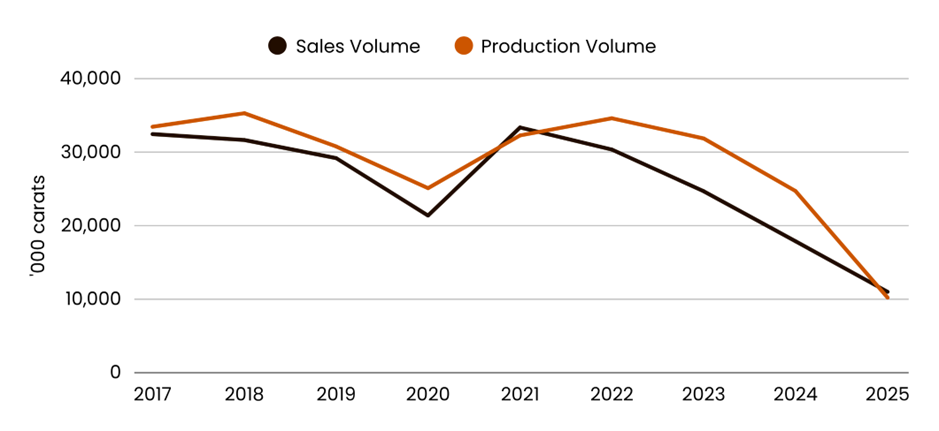
The reasoning is straightforward: the diamond market has been bullied by the rapid rise of lab-grown alternatives, and De Beers’ own numbers show the damage, sales volumes down roughly 46% and revenue down roughly 41% between 2021 and 2024. Venetia, which produced 2.23 million carats in 2025 and accounts for about 40% of South Africa’s total diamond output and 10.3% of De Beers’ global production, is being idled to cut costs and delay capital spending, with roughly 4,400 jobs affected.
What’s notable is why Venetia specifically, and not De Beers’ larger operations in Botswana or Namibia. Part of the answer is money: Venetia sits poorly on De Beers’ own global cost curve. Producing a carat in South Africa costs De Beers about $110, compared to just $38 in Botswana and $51 in Canada. Worse, what Venetia produces is not worth as much once it is out of the ground: its diamonds sold for an average of $66 a carat in 2025, versus $110 a carat for Botswana’s and a striking $353 a carat for Namibia’s. South Africa’s rough is simply smaller and lower-grade — exactly the tier of diamonds that lab-grown alternatives compete against hardest.
The other part of the answer is control. In South Africa, De Beers owns 74% of De Beers Consolidated Mines outright, with the remaining 26% held by Ponahalo Investments, a Black Economic Empowerment consortium. In Botswana and Namibia, De Beers’ presence is structured as strict 50/50 joint ventures with the respective governments — Debswana and Namdeb — meaning any decision to idle a mine needs government sign-off, not just a boardroom vote. South Africa is the one place De Beers can make this call largely on its own, and where the numbers already made the mine the easiest one to pause.
Whether “two years” holds is worth being skeptical about. The company making that promise may not be the one keeping it: Anglo American has been trying to offload De Beers since late 2025, and the shortlist of buyers is telling. Botswana’s government, which already holds a 15% stake in De Beers at the parent level, is one of the interested parties, and Angola has been negotiating for a stake of its own. A Botswana-influenced De Beers has an obvious incentive to prioritize its own mines first once the market turns, not a South African asset that was already the most expensive to run and the least valuable per carat. Two years is the timeline De Beers has committed to. Whether it’s the timeline South Africa actually gets depends on decisions the current owners may not be the ones making.
Source: De Beers pause from South Africa
Source: De Beers Preliminary Financial Results